
SynoCell and Cartilage: What Does Supports Cartilage Mean?
No. No supplement is shown to rebuild cartilage, and SynoCell is not an arthritis treatment. In the best test, ASU did not protect joint space on X-rays, a difference of only -0.12 mm against placebo. The label says supports cartilage, which is a structure claim with the FDA note, not a repair claim.
Does SynoCell rebuild cartilage? The key facts
Search phrases like joint repair and joint restoration promise a lot. Here is what the evidence can and cannot say.
Does SynoCell rebuild or repair cartilage?
No. The clearest test we have is joint space on an X-ray. It shows how wide the gap is between the bones, and that gap is a rough sign of how much cartilage cushions them. If a treatment protected cartilage, the gap would stay wider than with placebo.
ASU is the best-studied ingredient in SynoCell, and in the Cochrane review it did not do that. The difference from placebo was only -0.12 mm (Cameron & Chrubasik, Cochrane 2014). That is a tiny gap, and it was not a sign of protection.
For the other four ingredients, no human study shows cartilage growing back. Quercetin's joint evidence is lab and animal work (MSKCC About Herbs: Quercetin, 2023). Boswellia and oral hyaluronic acid trials measured pain and function scores, not cartilage.
So the plain answer is that nobody has shown SynoCell, or any supplement, rebuilds cartilage.
What does supports cartilage on the SynoCell label mean?
The label line reads: Promotes blood flow and supports cartilage†. It is a structure and function phrase. Under FDA rules, a supplement may say it supports a normal body structure, if it carries the note that the FDA has not evaluated the statement. It may not say it treats a disease (FDA Q&A on Dietary Supplements, 2026).
Reading the cartilage line with care
| Part of the line | What it can mean | What it does not mean |
|---|---|---|
| Promotes blood flow | The brand's wording; no study we found measured it | A proven effect in joints |
| Supports cartilage | The brand believes it supports normal joint structure | Repair, rebuilding or regrowth |
| The dagger symbol | Points to the FDA note on the label | That the FDA reviewed the claim |
*† These statements have not been evaluated by the Food and Drug Administration. This product is not intended to diagnose, treat, cure, or prevent any disease.
Does SynoCell help with arthritis?
SynoCell is not an arthritis treatment. No supplement treats arthritis. Osteoarthritis, the wear-related kind, is the one most trials look at. In those trials a few ingredients eased symptom scores slightly. None of them changed the joint.
The ACR and Arthritis Foundation guideline starts with exercise for all osteoarthritis, then weight loss for those who carry extra weight, where losing 5% or more can help (ACR/Arthritis Foundation guideline, 2019). In NIAMS's list of osteoarthritis care, exercise and weight loss appear and supplements do not (NIAMS Osteoarthritis). NCCIH calls the gains from ASU and boswellia slight, and says some people may find them too small to notice (NCCIH Osteoarthritis: In Depth).
Ask a doctor what is behind your joint pain, because other causes must be ruled out. Do that before you decide that a supplement is the next step.
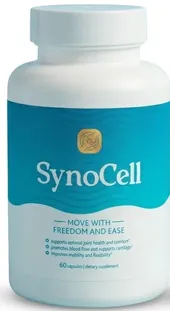
Want comfort support, not a cure?
If that is a fair goal for you, the live order page shows the price, the pledge and your shipping line.
Disclosure: Thesynocell earns money when an order goes through this site. The 90-day money-back pledge is a purchase policy, not a health promise.
Do cartilage supplements work in general?
People search for cartilage supplements, knee cartilage supplements and the best cartilage supplement. We do not rank products. We can tell you where the evidence stands for the ingredients in this one, and for the two that guidelines address.
Evidence on cartilage and symptoms, by ingredient
| Ingredient | On symptoms | On cartilage or joint space |
|---|---|---|
| ASU | Small to moderate drop in pain scores | No effect on joint space |
| Boswellia | Pain and function improved; quality uneven | No human study showing cartilage regrowth |
| Oral hyaluronic acid | Better scores in 9 of 11 small studies | No human study showing cartilage regrowth |
| Quercetin | No stand-alone joint trial | Lab and animal work only |
| Glucosamine and chondroitin | Advised against by the ACR for knee and hip osteoarthritis | Not part of SynoCell |
The ACR guideline strongly recommends against glucosamine and recommends against chondroitin, and a 2026 update keeps that advice (ACR OA guideline update summary, 2026). SynoCell contains neither. That guideline left out ASU, boswellia, oral hyaluronic acid and quercetin, so it says nothing for or against them.
How does SynoCell compare with other products, and what is better than SynoCell?
We found no head-to-head study of SynoCell against any other product, so nobody can say which is better. What you can do is compare facts. Use these questions on any joint product, including this one.
Five questions to ask of any joint product
| Question | SynoCell |
|---|---|
| Does the label list an amount for every active? | Yes, five amounts |
| Are the amounts near doses used in human studies? | ASU, boswellia and hyaluronic acid are; quercetin is far above its one trial |
| Does it rely on glucosamine or chondroitin? | No |
| Is there a refund window, and is it written down? | Yes, 90 days, with phone steps |
| Is a lab certificate from a named lab published? | No |
Other products may list different ingredients, different doses or a hidden blend. A product with an unusual blend of ingredients is not worse by default. But a product that hides its amounts makes comparison impossible.
What should you do if you want to look after your joints?
Move most days
Walking, gentle strength work and range-of-motion moves have the strongest support. Start slowly, and ask your doctor which exercises suit your joints.
Ease the load
Carrying extra weight? Losing 5% or more may take some strain off your knees and hips.
Get a diagnosis
Ask a doctor to name the cause of the pain, since other causes need to be ruled out.
Treat a supplement as a small extra
If you add one, expect a modest change at best, and keep notes so you can judge it.
Get medical advice first if a joint feels hot, looks red or swells up badly, if pain follows an injury, or if morning stiffness lasts longer than an hour.
Frequently asked questions
Does SynoCell rebuild cartilage?
No. Nothing in the research shows that any supplement rebuilds cartilage. In the Cochrane review, ASU failed to protect joint space better than placebo. The label says supports cartilage, which is not a repair claim.
Does SynoCell help with arthritis?
SynoCell is not an arthritis treatment. ASU and boswellia trials found small to moderate gains in symptom scores, and the formula itself has not been tested.
Is SynoCell better than glucosamine?
Nobody has compared the two directly. The ACR recommends against glucosamine for knee and hip osteoarthritis. The guideline did not look at ASU or boswellia, so it takes no side on SynoCell.
Does SynoCell contain glucosamine or chondroitin?
No. The five active ingredients do not include glucosamine or chondroitin.
Do cartilage supplements work?
Nothing shows that cartilage supplements rebuild cartilage. Some ingredients eased symptom scores a little in trials. Exercise and weight care come first.
What is better than SynoCell?
We found no study comparing SynoCell with other products, so we cannot name a better one. Compare labels, doses, refund terms and lab paperwork, and ask your doctor.
What does supports cartilage mean on the SynoCell label?
It is a structure claim: the ingredients are described as supporting cartilage, not changing it. This guide notes no supplement is shown to rebuild cartilage and that SynoCell is not a medicine.
Which SynoCell ingredients are linked to cartilage research?
ASU has the best-known tests, where joint space did not improve versus placebo. Hyaluronic acid has small studies and quercetin has almost none for joints. No trial tested the SynoCell formula.
Our view
We want to be blunt here, because this is where many pages stretch the truth. SynoCell does not rebuild cartilage, and it does not treat arthritis. The best evidence we have says ASU did not protect joint space, and the other ingredients were never tested for it.
What SynoCell may offer is modest comfort support for some adults. That is a smaller promise, and it is one the research can partly back. If that suits you, a fair 90-day trial with weekly notes is a sensible way to find out.
If you have a diagnosis, keep your treatment plan and tell your doctor about anything you add.
Be clear on the goal, then look at the price
Talk to your doctor about your joints first. The order page is there if you decide to try it.
Disclosure: Thesynocell earns money when an order goes through this site. Like every supplement, SynoCell is not FDA approved, because the FDA approves none of them. Ask your doctor or pharmacist about any medical question.
More from this site:
- Joint health guide
- Benefits
- ASU vs glucosamine
- Does SynoCell work for knee pain?
- What is SynoCell used for?
Last updated
