
Avocado Soybean Unsaponifiables (ASU) in SynoCell: Research, Dose and Safety
Avocado soybean unsaponifiables (ASU) is a plant oil fraction. SynoCell lists 310 mg per serving, close to the 300 mg a day used in trials. Four trials with 664 people found a small-to-moderate drop in knee and hip pain. ASU did not change joint space, and it comes partly from soy.
What is avocado soybean unsaponifiables (ASU) in SynoCell?
The leftover part of two plant oils, studied in knee and hip joints.
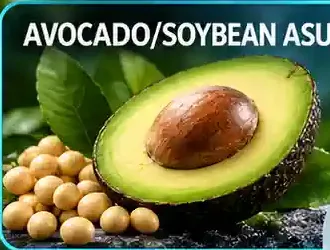
Avocado soybean unsaponifiables, or ASU, is a plant oil extract. It is the first ingredient on the SynoCell Supplement Facts, at 310 mg per 2-capsule serving.
The name sounds technical, but the idea is simple. When oils are treated to make soap, most of the oil turns into soap. A small part does not. That leftover part is called unsaponifiable.
ASU blends the unsaponifiable parts of avocado oil and soybean oil. It has been studied mostly in people with knee or hip osteoarthritis.
- Type
- Plant oil fraction from avocado and soybean
- Amount in SynoCell
- 310 mg per 2 capsules
- Studied dose
- 300 mg once a day
- Main studied use
- Knee and hip osteoarthritis comfort and function
How is ASU made from avocado and soybean oils?
Four steps from oil to capsule.
ASU comes from oil, not from the whole avocado or bean. Here is the basic route from fruit and bean to capsule.
- 1
Press the oils
Oil is taken from avocados and from soybeans.
- 2
Separate the fraction
The oils are processed. Most becomes soap-like material. A small unsaponifiable part is kept.
- 3
Blend the two
The avocado and soybean fractions are mixed. The best-studied product uses a 1:2 avocado to soybean ratio.
- 4
Fill the capsules
The blend goes into capsules. SynoCell lists 310 mg per serving.
The ratio matters for research. The trials tested one product, Piascledine 300, with that 1:2 ratio (Christensen et al., 2008). The ratio in SynoCell is not published.
What does research say about avocado soybean unsaponifiables for osteoarthritis?
Four trials, 664 people, one consistent small effect.
Research shows a small-to-moderate benefit for symptoms. A 2008 meta-analysis pooled 4 trials with 664 people. About 59% had knee osteoarthritis and 41% had hip osteoarthritis (Christensen et al., 2008).
Here are the main numbers in plain words.
- Pain effect size
- 0.39small to moderate
- Function effect size
- 0.45Lequesne index
- Number needed to treat
- 61 extra responder per 6 people
Key ASU results
| Measure | Result | What it means |
|---|---|---|
| Pain (Cochrane) | 8.5 points lower on a 0–100 scale | A noticeable but modest change |
| Function (Cochrane) | 7 mm better | Small gain in daily tasks |
| Responders | Odds ratio 2.19 | About twice the odds of a good response |
| Knee vs hip | Benefit looked more likely in knees | Hip results were weaker |
| Funding | All 4 trials industry-funded | A reason for some caution |
The Cochrane authors call the ASU benefit small and clinically questionable (Cameron & Chrubasik, Cochrane 2014). Put simply, some people may notice easier stairs or walks. Many will notice little.
Ready to try SynoCell?
Best value$39 a bottle · $234 for 6
Avocado soybean unsaponifiables 300 mg vs the 310 mg in SynoCell
Close in amount. Not proven equal in product.
The SynoCell amount is a close match to the trial dose. Trials gave 300 mg once a day. SynoCell lists 310 mg per serving.
There is one real caveat. A match in milligrams is not a match in product. The trials used Piascledine 300, made at a 1:2 avocado to soybean ratio. Other ASU ingredients may be made differently, and the SynoCell ratio is not published.
One study in the Cochrane review suggested benefit at 600 mg too. More is not clearly better, so stick to the label serving. See how to use SynoCell for routine tips.
Does ASU protect or rebuild cartilage?
Symptoms changed in trials. Joint space did not.
No. The research does not show that ASU protects or rebuilds cartilage. The Cochrane review looked at joint space, the gap between bones that shrinks as cartilage thins. ASU did not preserve it. The difference from placebo was -0.12 mm (Cameron & Chrubasik, Cochrane 2014).
NCCIH sums up ASU as giving slight improvements in pain and function, possibly too small to matter to some people (NCCIH Osteoarthritis: In Depth).
The SynoCell bottle says it supports cartilage. That is a label claim in the brand's words, with the FDA note. It is not a promise of repair.
ASU vs glucosamine: what the guidelines say
One is not assessed. The other is advised against.
Guidelines treat these two very differently. The 2019 American College of Rheumatology and Arthritis Foundation guideline strongly recommends against glucosamine for knee and hip osteoarthritis (ACR/Arthritis Foundation guideline, 2019).
ASU was not assessed, because most nutraceuticals were left out of that guideline. The 2026 update summary also does not mention ASU (ACR OA guideline update summary, 2026).
ASU and glucosamine side by side
| Question | ASU | Glucosamine |
|---|---|---|
| Guideline view (ACR 2019) | Not assessed | Strongly recommended against |
| Best evidence | Meta-analysis of 4 trials; Cochrane review | Reviewed by the ACR guideline panel |
| In SynoCell? | Yes, 310 mg | No |
What the guidelines do strongly recommend is exercise for everyone with osteoarthritis, and weight loss for people with extra weight. Losing 5% or more can matter. Our post ASU vs glucosamine goes deeper.
ASU supplement side effects and soy allergy
Thin safety data, and one allergen to check.
The ASU research summaries focus on pain and function, not on harms. NCCIH notes that little safety information exists for herbs like ASU (NCCIH Osteoarthritis: In Depth). Long-term safety data are thin.
Pregnancy and breastfeeding were not studied. For the whole formula, read SynoCell side effects.
Start your 90-day window today
Best value$39 a bottle · $234 for 6
Is ASU in SynoCell a fit for you?
Four questions, nothing saved.
Answer these four quick questions. They are a starting point, not medical advice.
Compare ASU with the other four in the SynoCell ingredients overview.
Sources for this ASU page
Every number above links back to one of these.
- Christensen R, Bartels EM, Astrup A, Bliddal H. Symptomatic efficacy of avocado-soybean unsaponifiables (ASU) in osteoarthritis (OA) patients: a meta-analysis of randomized controlled trials. Osteoarthritis and Cartilage. 2008;16(4):399-408. doi:10.1016/j.joca.2007.10.003. (Author order: first three from a citing reference list, Bliddal from the KB Pure record.) SourceDose studied: ASU 300 mg once daily (Piascledine 300, avocado:soybean 1:2); 4 RCTs, 664 people with hip (41.4%) or knee (58.6%) OA.. Pooled effect size was 0.39 for pain and 0.45 for the Lequesne function index; responder odds ratio 2.19 (NNT 6); benefit looked more likely in knee than hip OA, and all four trials were industry-funded.
- Cameron M, Chrubasik S. Oral herbal therapies for treating osteoarthritis. Cochrane Database of Systematic Reviews 2014, Issue 5. Art. No.: CD002947. doi:10.1002/14651858.CD002947.pub2. SourceDose studied: 49 RCTs, 5,980 participants. ASU 300 mg/day (one study suggested benefit at 600 mg); Boswellia serrata enriched extract 100 mg/day (single studies at 250 mg and 999 mg/day, low quality).. Moderate-quality evidence: ASU cut pain by 8.5 points on a 0-100 scale and improved function by 7 mm, but did not preserve joint space (difference -0.12 mm); Boswellia enriched extract cut pain by 17 points and improved function by 8 points; authors call ASU's benefit small and clinically questionable.
- National Center for Complementary and Integrative Health. Osteoarthritis: In Depth. Last updated September 2016. SourceDose studied: General overview; no doses.. A 2014 review found ASU and Boswellia serrata may produce slight improvements in pain and function, possibly too small to matter to patients; little safety information exists for these herbs; FDA has warned about arthritis supplements secretly tainted with prescription drugs.
- Kolasinski SL, Neogi T, Hochberg MC, et al. 2019 American College of Rheumatology/Arthritis Foundation Guideline for the Management of Osteoarthritis of the Hand, Hip, and Knee. Arthritis & Rheumatology. 2020;72(2):220-233. SourceDose studied: Not applicable (guideline).. Strongly recommends exercise for all OA and weight loss for overweight knee/hip OA (>=5% loss can matter); strongly recommends against glucosamine, against chondroitin for knee/hip, and conditionally against fish oil and vitamin D; ASU, boswellia and turmeric were not assessed because most nutraceuticals were excluded.
- U.S. Food and Drug Administration. Food Allergies. Content current as of 11 March 2026. SourceDose studied: Not applicable.. Soybeans are one of the nine major food allergens in the U.S., and labels must identify the food source of any major allergen used.
Avocado soybean unsaponifiables questions
What are avocado soybean unsaponifiables?
Avocado soybean unsaponifiables (ASU) are the small part of avocado and soybean oils that does not turn into soap when the oils are processed with an alkali. That fraction is mixed and sold as a supplement, and it has been studied in knee and hip osteoarthritis.
What are the benefits of avocado soybean unsaponifiables?
In trials, ASU gave a small-to-moderate drop in osteoarthritis pain and a modest gain in daily function. A Cochrane review measured pain down 8.5 points on a 0–100 scale (Cameron & Chrubasik, Cochrane 2014). It did not change joint space on X-rays.
Is avocado soybean unsaponifiables 300 mg the right dose?
300 mg once a day is the dose used in the main ASU trials. SynoCell lists 310 mg per 2-capsule serving, which is a close match in amount. One Cochrane-reviewed study suggested benefit at 600 mg as well.
Does ASU rebuild cartilage?
No. The Cochrane review found ASU did not preserve joint space, with a difference of -0.12 mm from placebo (Cameron & Chrubasik, Cochrane 2014). Studies show symptom changes, not cartilage repair.
What are the side effects of an ASU supplement?
The research focuses on benefits, and NCCIH notes that little safety information exists for ASU. The main known caution is soy, because ASU comes partly from soybean oil.
Can I take ASU if I am allergic to soy?
Ask your clinician first. Soybeans are one of the nine major U.S. food allergens. Whether the ASU in SynoCell contains soy protein is not published, so do not assume it is safe for a soy allergy.
Is ASU better than glucosamine?
They have not been compared head to head in the sources here. The 2019 ACR guideline strongly recommends against glucosamine for knee and hip osteoarthritis (ACR/Arthritis Foundation guideline, 2019). It did not assess ASU at all, so it neither recommends nor rejects it.
How long does ASU take to work?
There is no set timeline. ASU trials lasted months rather than days, and results were measured as average changes over that time. Give any joint supplement several weeks and track how stairs and walks feel.
Is avocado soybean unsaponifiables for dogs the same thing?
The ingredient is the same type, but products for animals are made and dosed for animals. SynoCell is for adult humans only. Ask a vet about pet products.
Ready to try SynoCell?
Order from the U.S. authorized merchant, keep your order email, and you are covered by the 90-day money-back guarantee. Questions first? Call +1 (302) 200-3480.
- Secure checkout
- 90-day money-back pledge
- Ships from the US
- Tracking by email
Keep reading
Ingredients
All five ingredients, each label amount next to the dose used in studies.
Read more →Boswellia
Indian frankincense extract: 200 mg vs the 100–250 mg studied, mixed-quality trials, two medicine checks.
Read more →ASU vs glucosamine
ASU trial results, the Cochrane view and why the ACR guideline advises against glucosamine and chondroitin.
Read more →