
SynoCell for Knee Pain: What Do the 664-Person Trials Show?
No trial has tested SynoCell itself, so no one can promise it works for knee pain. Trials of ASU at 300 mg a day, with 664 people, found small to moderate gains, and boswellia trials were promising but uneven. SynoCell's ASU and boswellia amounts sit inside or close to those studied doses.
Does SynoCell work for knee pain? The key facts
The honest answer has two parts. For the formula: unknown. For the ingredients: a little, for some people. Here are the facts that sit behind both parts.
SynoCell amounts next to the research behind them
| Ingredient | SynoCell per serving | Studied amount | What trials found |
|---|---|---|---|
| ASU | 310 mg | 300 mg a day | Small to moderate drop in pain; no effect on joint space |
| Boswellia extract | 200 mg | 100 to 250 mg | Pain and function improved; quality uneven |
| Hyaluronic acid | 180 mg | 30 to 300 mg a day | Better scores in 9 of 11 small studies |
| Quercetin | 310 mg | 45 mg in a mix | Cannot be separated from its partners |
| BioPerine | 5 mg | 20 mg, absorption only | No joint effect studied |
How does SynoCell work, in plain words?
Each ingredient was picked because it has some research on its own. The brand's idea is that five parts together support joint comfort. Nobody has measured the five together.
- ASU and boswellia are studied for knee and hip comfort and daily function.
- Hyaluronic acid is a natural part of joint fluid, studied here by mouth.
- Quercetin is a flavonoid with lab and animal joint data, not stand-alone human trials.
- BioPerine changes how the gut absorbs other compounds. On its own it has no joint effect.
So when someone asks how SynoCell works, the fair answer is: we know what each part was studied for, and we do not know how the mix behaves. The BioPerine idea, that 5 mg helps the other four ingredients get absorbed, has not been measured for this capsule. Treat it as a theory.
What did the ASU trials find for knee pain?
ASU has the best data of the five. A pooled analysis took four randomized trials, with 664 people, that used a 300 mg a day product. Pain scores fell with an effect size of 0.39. A function index improved with an effect size of 0.45. About one extra person in six responded compared with placebo (Christensen et al., 2008).
Three limits matter. Industry paid for all four of those trials. The gain seemed likelier at the knee than at the hip. And a Cochrane review put the average extra pain drop at 8.5 points on a 0 to 100 scale, called the benefit small, and found no effect on joint space (Cameron & Chrubasik, Cochrane 2014).
SynoCell lists 310 mg of ASU, only 10 mg above the trial dose. That is a good sign for the amount. It does not make the product the same as the trial product, which had a 1 to 2 ratio of avocado to soybean.
What did the boswellia and hyaluronic acid studies find?
Boswellia
Seven trials, 545 people, extracts of 100 to 250 mg. Pooled results favored boswellia for pain, stiffness and function. WOMAC pain fell by about 14 points, and a visual pain scale fell by 8.3 points. Trial quality varied so much that NCCIH asks for bigger, better studies (Yu et al., 2020) (NCCIH Boswellia, 2025). A Cochrane summary of an enriched extract at 100 mg a day reported a 17-point drop on the same 0 to 100 scale (Cameron & Chrubasik, Cochrane 2014).
Oral hyaluronic acid
A review of 11 small studies, with 597 people, found better pain or function scores in 9 of them. Doses ran from 30 to 300 mg a day, and the review gave no pooled effect size (de Carvalho & Davidson, 2024). It is early and limited.
In both cases the studies used their own products. SynoCell's 200 mg of boswellia and 180 mg of hyaluronic acid fall inside the ranges, which is a fair start and not a proof.
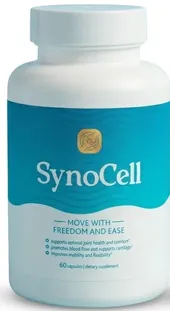
Want to test it on your own knees?
A 90-day pledge gives you time to track stairs and walks, and the live checkout shows the current terms.
Disclosure: Thesynocell earns money when an order goes through this site. The 90-day money-back pledge is a purchase policy, not a health promise.
How big is a small to moderate gain on a sore knee?
Numbers like 0.39 and 8.5 points are hard to feel, so here is a simple picture.
What the ASU numbers could mean in everyday terms
| Number from the trials | In plain words |
|---|---|
| 8.5 points lower on a 0 to 100 pain scale | If your knee pain sits at 60 out of 100, it might drop by 8 or 9 points on average, to the low 50s |
| About 1 extra responder per 6 treated | In a room of 12 people, about 2 more would respond than on placebo |
| Effect size 0.39 | Small to moderate, a gain that some people notice and others do not |
These are rough pictures from averages. They are not forecasts for you. NCCIH says the gains from ASU and boswellia may be too small to matter to some people (NCCIH Osteoarthritis: In Depth). On the other hand, a few points can feel real if you climb stairs every day.
Do joint supplements work as well as exercise and weight care?
No supplement has been shown to match them. The ACR and Arthritis Foundation guideline lists exercise first for every case of osteoarthritis. For knee or hip osteoarthritis with extra body weight, it adds weight loss, and a loss of 5% or more can make a difference (ACR/Arthritis Foundation guideline, 2019). NIAMS lists exercise and weight loss as care steps, and does not list supplements (NIAMS Osteoarthritis).
The same guideline recommends against glucosamine and chondroitin, and a 2026 update keeps that advice (ACR OA guideline update summary, 2026). SynoCell contains neither one. The guideline did not assess ASU, boswellia, oral hyaluronic acid or quercetin, so it neither backs nor rejects them.
So the sensible order is movement first, weight care second, and a capsule as a small extra if you and your doctor agree.
Who is most likely to notice a change, and who should see a doctor first?
- Adults with everyday knee stiffness, on stairs or after sittingBest fit
- People who already walk or plan to startBest fit
- People who can give it 8 to 12 weeks and keep notesBest fit
- Hip, hand or back stiffness: little research on these ingredientsLess certain
- A hot, red or very swollen joint, or pain after a fall or twistSee a doctor
- Sudden severe pain, fever, or stiffness lasting over an hour each morningSee a doctor
- Pets: SynoCell is for adult humans onlyNot for pets
Check with a doctor or pharmacist before starting if you use blood thinners or other prescriptions, or have a soy allergy, kidney disease or take asthma medicine. Pregnancy and breastfeeding have not been studied.
Frequently asked questions
Does SynoCell work for knee pain?
No one can say for the formula, because it has not been tested. Trials of ASU and boswellia found small to moderate average gains in knee pain scores. Results vary from person to person.
Does SynoCell actually relieve pain?
It is a dietary supplement, not a pain drug. Any change from the ingredients tends to be small and slow, over weeks, not hours.
Is SynoCell effective?
Its ASU, boswellia and hyaluronic acid amounts sit near studied doses, but the formula has no trial of its own. So its effect is not established.
Do joint supplements really work?
Some help a little. ASU and boswellia show small to moderate gains in trials. Guidelines advise against glucosamine and chondroitin and put exercise and weight care first.
How does SynoCell work?
It combines five ingredients studied one by one for joint comfort or absorption. How they act together has not been measured.
Can SynoCell replace exercise or weight loss?
No. For knee and hip osteoarthritis, guidelines list exercise and weight loss ahead of any supplement. A capsule can only be a small add-on.
Is SynoCell good for knee pain?
Evidence is indirect: ASU and boswellia trials showed small to moderate gains, but the SynoCell formula was never tested. Exercise and weight control come first, and the 90-day pledge limits your money risk.
How much ASU is in SynoCell compared with knee pain trials?
SynoCell has 310 mg of ASU per 2-capsule serving, close to the 300 mg a day used in the trials with 664 people. Those trials tested ASU alone, not the full formula.
Our view
If you want a yes or a no, we cannot give you one. What we can give you is a clear picture. The ingredients have modest research behind them. The formula has none. The effect sizes are small to moderate, and people differ.
We think a fair attempt is reasonable for an adult with everyday knee stiffness who has no medicine conflicts. Use 2 capsules a day, keep walking, write down stairs and morning stiffness each week, and decide by day 75. If nothing changes, that is a useful answer, and the pledge is there for it.
Be wary of any page that promises more. Cartilage repair and pain-free days are not shown by any study we cite.
If you decide to try it, start with the facts
Read the guarantee, then look at the live order page for the price and shipping line.
Disclosure: Thesynocell earns money when an order goes through this site. Like every supplement, SynoCell is not FDA approved, because the FDA approves none of them. Ask your doctor or pharmacist about any medical question.
More from this site:
- How it works
- Ingredients
- Do joint supplements work?
- How long SynoCell takes to work
- Does SynoCell rebuild cartilage?
Last updated
