
How SynoCell Works for Knee and Hip Comfort
SynoCell combines five ingredients that were each studied on their own.
ASU 310 mg and boswellia 200 mg were studied for knee and hip comfort, hyaluronic acid 180 mg is taken by mouth, quercetin 310 mg is added, and BioPerine 5 mg helps absorption.
For the exact label, view the Supplement Facts.
How does SynoCell work? The short version
Five studied ingredients, one untested formula.
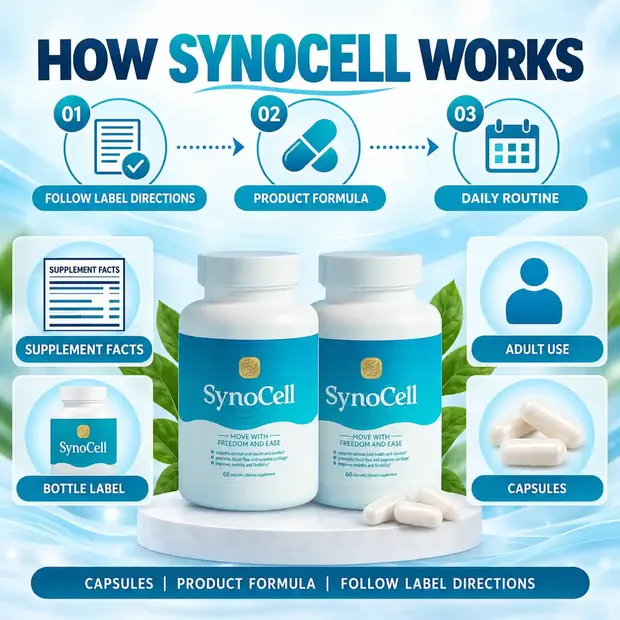
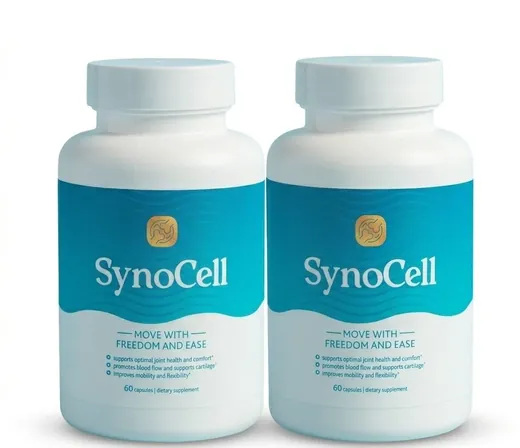
SynoCell is a joint-comfort capsule with five ingredients. Each one was chosen because it has been studied on its own for joint comfort, or for absorption. The brand serving is 2 capsules a day, and one bottle holds 60 capsules.
Here is the honest part. No study has tested the SynoCell formula itself. So we can explain what each ingredient was studied for, and how strong that research is. We cannot tell you how the five work together, because nobody has measured that.
The brand describes the goal in its own words: "Move with freedom and ease." The rest of this page shows what sits behind those words, one ingredient at a time.
What each SynoCell ingredient is studied for, and what the evidence shows
Studied for, versus what the research actually found.
Walk through the formula in the order of how much research backs each part. The first two have the most human trials. The last two have the least joint evidence.
- 1
ASU 310 mg: studied for knee and hip comfort
Four trials of a 300 mg ASU product found small-to-moderate gains in pain and function. For every 6 people treated, about 1 more felt better than on placebo. It did not protect joint space.
- 2
Boswellia 200 mg: studied for knee pain and stiffness
Pooled trials favored boswellia for pain, stiffness and function. Trial quality varied a lot, and NCCIH asks for bigger, better studies.
- 3
Hyaluronic acid 180 mg: studied as a pill
Hyaluronic acid is a natural part of joint fluid. In 9 of 11 small oral studies, scores for pain or stiffness improved. No pooled size was given.
- 4
Quercetin 310 mg: no stand-alone joint trial
The only knee trial used 45 mg a day mixed with glucosamine and chondroitin. Quercetin's own joint evidence is from lab and animal work.
- 5
BioPerine 5 mg: changes absorption
Piperine changes how the body takes in other compounds. It has no joint benefit of its own, and it can affect some medicines.
Sources: Christensen et al., 2008, Yu et al., 2020, NCCIH Boswellia, 2025, de Carvalho & Davidson, 2024, Kanzaki et al., 2012, MSKCC About Herbs: Quercetin, 2023 and Shoba et al., 1998. Full details are on the SynoCell ingredients page.
SynoCell dose vs the doses used in research
Close for ASU and hyaluronic acid. Untested for quercetin.
A label amount only matters if it is close to what was studied. Here is the side-by-side, using the brand's Supplement Facts for one 2-capsule serving.
SynoCell label amounts vs studied amounts
| Ingredient | SynoCell per serving | Amount in research | How strong is the evidence? |
|---|---|---|---|
| ASU | 310 mg | 300 mg a day | Moderate: 4 trials, 664 people, all industry-funded |
| Boswellia extract | 200 mg | 100–250 mg a day | Mixed: 7 trials, very uneven quality |
| Hyaluronic acid | 180 mg | 30–300 mg a day | Limited: 11 small studies, no pooled size |
| Quercetin | 310 mg | 45 mg a day, in a combination | Weak for joints: lab and animal work |
| BioPerine (piperine) | 5 mg | 20 mg in absorption studies | Absorption only, not joints |
Two cautions on reading this table. First, a similar amount is not the same product. The ASU trials used one specific product with a 1:2 avocado-to-soybean ratio, and boswellia extracts differ. Second, "65% boswellic acids" on a label does not make it the same extract as a trial used. More detail is on the SynoCell Supplement Facts page.
Ready to try SynoCell?
Best value$39 a bottle · $234 for 6
How big are the effects behind SynoCell's ingredients?
Small average changes. Some people respond more.
Research reports pain on a 0 to 100 scale. Lower is better. The bars show how much ASU and boswellia lowered pain compared with placebo, on average. Hyaluronic acid has no pooled number, so it is not shown.
Average pain drop vs placebo, 0–100 scale
For context, the Cochrane authors called ASU's benefit small and "clinically questionable" (Cameron & Chrubasik, Cochrane 2014). NCCIH says the gains from ASU and boswellia may be too small to matter to some patients (NCCIH Osteoarthritis: In Depth). On the other hand, a few points can still feel real when you climb stairs every day. The fair summary is modest help for some people, not a big change for most.
Does SynoCell repair cartilage? The honest answer
Comfort support, not repair.
No. SynoCell is not shown to repair, rebuild or restore cartilage, and no supplement has been shown to do that. People search for "synocell joint repair" and "synocell joint restoration," so we want to answer clearly.
The best test is joint space on an X-ray. It shows how much cartilage cushions the bones. In the Cochrane review, ASU did not preserve joint space, with a difference of only −0.12 mm against placebo (Cameron & Chrubasik, Cochrane 2014). None of the other four ingredients has a human study showing cartilage regrowth.
The bottle says "supports cartilage." That is a structure/function phrase, marked with the FDA disclaimer. It means the brand believes the formula supports normal joint structure. It is not a claim of repair, and we explain the wording on the SynoCell benefits page.
Why SynoCell adds black pepper extract (BioPerine)
A helper ingredient, with a medicine caveat.
BioPerine is a black pepper fruit extract standardized for piperine. Its job is absorption. In a classic study, 20 mg of piperine raised how much curcumin reached the blood by about 2000% (Shoba et al., 1998). That study did not test joints, and it did not test the five SynoCell ingredients.
So the idea is that 5 mg of BioPerine may help the body take in the other ingredients. That has not been measured for SynoCell.
The same effect can touch medicines. Piperine slows some drug-clearing enzymes. At 15 to 20 mg a day it raised blood levels of several drugs (Horn & Hansten, Pharmacy Times 2017). Whether 5 mg does the same is unknown, so ask a pharmacist if you take prescription medicine. See the BioPerine ingredient page.
Where SynoCell fits next to exercise and weight
Movement first, supplement second.
Doctors have a clear first step for knee and hip osteoarthritis. The American College of Rheumatology strongly recommends exercise for everyone with osteoarthritis. It also strongly recommends weight loss for people who are overweight, where losing 5% or more can matter (ACR/Arthritis Foundation guideline, 2019).
The same guideline recommends against glucosamine and chondroitin. It did not assess ASU, boswellia, oral hyaluronic acid or quercetin, so it neither backs nor rejects SynoCell. NIAMS lists exercise and weight loss among treatments, not supplements (NIAMS Osteoarthritis).
First: move
Walking, gentle strength work and range-of-motion moves have the strongest support.
Second: weight
For knees and hips, a small loss in weight can lower load on each step.
Then: SynoCell, if you choose
A modest add-on for everyday stiffness, taken at 2 capsules a day.
Our joint health guide has simple moves to start with.
Does SynoCell work? What the evidence can and cannot tell you
Reasonable ingredients, unproven formula.
Reasons it may help
- ASU at 310 mg matches the trial dose closely
- Boswellia and hyaluronic acid amounts sit inside studied ranges
- Side effects in the ingredient studies were mostly few and mild
- The 90-day money-back pledge gives time to judge
Limits to keep in mind
- No study has tested the SynoCell formula
- Average effects are small, and ASU trials were all industry-funded
- Quercetin's joint evidence is mostly lab and animal work
- Boswellia, quercetin and piperine can interact with blood thinners
Want a plan for judging it yourself? The SynoCell results timeline shows what to track over the pledge window.
SynoCell how-it-works questions
How does SynoCell work?
SynoCell combines five ingredients that were each studied on their own for joint comfort or absorption. ASU, boswellia and oral hyaluronic acid have small human trials in knee and hip osteoarthritis. No study has tested the SynoCell formula itself, so how well the mix works together is not known.
Does SynoCell work for joint pain?
It may help some people a little, but nothing is promised. ASU and boswellia trials found small average drops in pain scores. Those trials used their own products, not SynoCell. Results vary from person to person.
Does SynoCell repair cartilage?
No. No supplement has been shown to repair or rebuild cartilage. In the best review of ASU, it did not protect joint space compared with placebo. The bottle's words are "supports cartilage," which is a structure/function phrase, not a repair claim.
What is SynoCell joint restoration or joint repair supplement?
Those are search phrases, not claims this site can back up. SynoCell is a joint-comfort dietary supplement. It is not shown to restore joints, repair cartilage or treat arthritis.
Why is black pepper extract in SynoCell?
Black pepper extract (BioPerine, 5 mg) contains piperine, which changes how the body absorbs other compounds. That is its only known role. Piperine can also raise blood levels of some medicines, so ask a pharmacist if you take any.
Is boswellia an anti-inflammatory?
NCCIH says oral boswellia may help reduce osteoarthritis pain and inflammation. It also says larger, better studies are needed. The trials so far vary widely in quality.
Is the SynoCell dose the same as in studies?
For two ingredients it is close. ASU is 310 mg against about 300 mg in trials, and hyaluronic acid is 180 mg inside the 30 to 300 mg range studied. Boswellia at 200 mg sits inside the 100 to 250 mg range. Quercetin has no matching joint trial.
Is SynoCell FDA approved?
No. The FDA does not approve dietary supplements or their claims before sale. SynoCell's label claims carry the standard FDA disclaimer.
Is SynoCell better than glucosamine?
No head-to-head study exists. The American College of Rheumatology recommends against glucosamine for knee and hip osteoarthritis. It did not assess ASU or boswellia, so it says nothing either way about SynoCell. See our ASU vs glucosamine article.
Ready to try SynoCell?
Order from the U.S. authorized merchant, keep your order email, and you are covered by the 90-day money-back guarantee. Questions first? Call +1 (302) 200-3480.
- Secure checkout
- 90-day money-back pledge
- Ships from the US
- Tracking by email
Keep reading
Ingredients
All five ingredients, each label amount next to the dose used in studies.
Read more →Side effects
Side effects and interactions for each SynoCell ingredient, and when to stop.
Read more →Do joint supplements work?
What trials and guidelines say about joint supplements, how long to wait and how to judge any product.
Read more →